
Title 24 Window Requirements in California: U-Factor and SHGC Explained
Under California's 2025 Energy Code, a replacement window generally needs a U-factor of 0.30 or lower in climate zones 6 through 10 and 15, or 0.27 or lower in the other zones, and a solar heat gain coefficient of 0.23 or lower except in zones 1, 3, 5 and 16. The NFRC label proves both numbers.
What does Title 24 require of a replacement window in 2026?
Title 24, Part 6 is the California Energy Code. The 2025 edition took effect January 1, 2026, and the rule for window alterations in houses lives in Section 150.2(b)1. It sends you to Table 150.1-A, which sets two maximums: a U-factor and a solar heat gain coefficient, or SHGC. The California Energy Commission's compliance form for simple alterations, CF1R-ALT-05-E, revised May 1, 2026, prints the values in its instructions.
For U-factor, the form says 0.27 in climate zones 1 through 5, 11 through 14 and 16, and 0.30 in zones 6 through 10 and 15. For SHGC it says 0.23, with no requirement in zones 1, 3, 5 and 16. Lower is stricter for both. These are the prescriptive numbers, the route with no energy modeling, used for most window replacement jobs.
Which climate zone is your house in, and why are there two U-factor limits?
California is divided into sixteen building climate zones, and the Energy Commission's climate zone tool assigns one to any address. The code's reference city for each zone gives a feel for the Southern California map: Torrance for zone 6, San Diego for zone 7, Fullerton for zone 8, Burbank and Glendale for zone 9, Riverside for zone 10, Palmdale for zone 14 and Palm Springs for zone 15.
Put those next to the form and the split makes sense. The coastal and inland valleys, zones 6 through 10, and the low desert, zone 15, use 0.30. The high desert around Palmdale, zone 14, uses the tighter 0.27, and so does zone 16. U-factor measures heat moving through the window, so colder winter nights get the stricter number. A product that passes in Burbank can fail an hour north.
Zone boundaries can cut through a ZIP code, so look up the address, not the city name.
How do you read U-factor and SHGC on an NFRC label?
The National Fenestration Rating Council's label guide explains each box. U-factor measures how well a product keeps heat from escaping, on a scale of 0.20 to 1.20, and lower is better. SHGC measures how much solar heat the product lets in, from 0 to 1, and a low number blocks more sun. Visible transmittance, also 0 to 1, is how much daylight comes through. Air leakage must be 0.3 or less.
The Energy Code makes the label mandatory, not optional. The Commission's 2025 single-family mandatory measures summary says U-factor and SHGC must be rated under NFRC 100 and NFRC 200 or taken from the code's default tables, and that manufactured windows must limit air leakage to 0.3 cubic feet per minute per square foot. Ask the supplier for the label values before you order, because a window without a rating falls back on the code's default tables instead.
Is there an exception for replacing only a few windows?
Yes, a narrow one. The same CF1R-ALT-05-E instructions list a separate alteration type for replacing 75 square feet or less of window area. For that case the maximum U-factor is 0.40 and the maximum SHGC is 0.35. Local handouts repeat it: the City of Torrance's window replacement guideline, dated May 2026, allows 0.40 and 0.35 only when replacing a maximum of 75 square feet of glazing, and 0.30 and 0.23 otherwise.
Two more lines on the forms are worth knowing. Replaced skylights get their own limits of 0.40 and 0.30. And a door that is 25 percent glass or more is treated as a window, so a new patio slider counts toward your square footage and has to meet the same table.
- Whole-house replacement, zones 6 through 10 and 15: U-factor 0.30, SHGC 0.23.
- Whole-house replacement, zones 2, 4 and 11 through 14: U-factor 0.27, SHGC 0.23.
- Zones 1, 3, 5 and 16: U-factor 0.27, no SHGC requirement.
- Replacing 75 square feet or less: U-factor 0.40, SHGC 0.35.
- Any window in conditioned space: mandatory area-weighted average U-factor of 0.40 at most.
A worked example: does one custom window sink the whole order?
Not necessarily, because the code lets you average by area. The state forms say a weighted average may be used to reach the required maximum, documented on worksheet CF1R-ENV-02-E. Here is the arithmetic for a house in the San Fernando Valley that the lookup tool places in climate zone 9, where the limit is 0.30.
The order is nine windows totaling 140 square feet. Eight stock units add up to 120 square feet at a U-factor of 0.28. The ninth is a 20 square foot arched picture window whose label reads 0.40. Multiply each area by its U-factor: 120 x 0.28 = 33.6, and 20 x 0.40 = 8.0. Add them, 33.6 + 8.0 = 41.6, and divide by the total area: 41.6 / 140 = 0.297. That is under 0.30, so the order passes as a group.
Move the same house to Palmdale and the limit drops to 0.27. Now 0.297 fails, and you would need better stock units or a better arch.
Why do city handouts and contractors quote different numbers?
Mostly because they are in different zones, and partly because some handouts are old. Unincorporated Orange County's window handout, revised December 2025, says replacement windows need a U-factor of 0.3 and an SHGC of 0.23. San Bernardino County's, revised May 2026, says 0.30 and 0.23. The City of Elk Grove near Sacramento, zone 12, says 0.27 and 0.23 on a form dated January 2026. All three match the state table for where they sit.
Then there are handouts that still cite the 2019 or 2022 code. Tustin's 2019-era guide and Agoura Hills' 2022-era handout both print 0.30 and 0.23 with no zone split. A salesperson who learned 0.30 years ago and sells in zone 14 is now wrong. The City of Los Angeles keeps it short: its Express Permit bulletin requires NFRC-certified dual glazing on replacement windows in homes of three stories or less, as our guide to window permits in Los Angeles explains.
What paperwork and inspection steps go with a Title 24 window job?
Two state forms carry it. The certificate of compliance, CF1R-ALT-05-E, lists each replaced window with its area and its proposed U-factor and SHGC. The certificate of installation, CF2R-ENV-01-E, is signed by the installer. It states that the installed values must be equal to or less than those on the CF1R, that temporary labels stay on until the building inspector verifies them, and that the gap between the window and the rough opening must be completely filled with insulation.
MDG Builders, CSLB #1040337, prepares the compliance forms with the permit, and the licensed subcontractor who installs the windows signs the installation certificate. If the job is part of a larger room addition or an ADU, the windows are usually folded into that project's energy report instead.
Does glass-only repair, a fire zone or a tax credit change the answer?
Repair is treated differently from replacement. Elk Grove's 2026 form notes that glass replaced in an existing sash and frame, or sashes replaced in an existing frame, are considered repairs. Ask your own building department whether it reads the rule the same way before assuming a reglaze is exempt.
Fire zones stack on top. In a mapped Fire Hazard Severity Zone, the LADBS checklist calls for at least one tempered pane in a multilayered unit, and the window must still meet the energy table. Frame choice affects the numbers too, as our frame material comparison shows.
On money: the federal Energy Efficient Home Improvement Credit no longer applies. The IRS says it covered windows placed in service before December 31, 2025.
Title 24 window questions
What is a Title 24 window?
It is a window whose NFRC-rated U-factor and SHGC meet the California Energy Code for your climate zone. For most replacement jobs in 2026 that means a U-factor of 0.30 or 0.27 at most, depending on zone, and an SHGC of 0.23 at most where one applies. There is no separate Title 24 product category.
Are double pane windows required in California?
In practice, yes for replacements. The City of Los Angeles requires NFRC-certified dual glazing on replacement windows in residential buildings of three stories or less, and the Energy Code's U-factor limits of 0.27 to 0.30 are far below what single-pane glass achieves. The code sets performance numbers, and dual glazing is how products meet them.
What do U-factor and SHGC ratings mean?
U-factor is how readily heat passes through the window, and SHGC is the share of the sun's heat it lets in. The NFRC rates U-factor from 0.20 to 1.20 and SHGC from 0 to 1. For both, a lower number means less heat moving through the glass and frame.
What triggers a Title 24 energy review on windows?
Replacing or adding windows in a conditioned house triggers it. Section 150.2(b)1 of the Energy Code applies to altered fenestration, and the CF1R-ALT-05-E form documents it. Replacing 75 square feet or less qualifies for looser limits, and glass-only repair in an existing sash may be treated as a repair.
Do double pane windows make a difference in Southern California?
Yes. The U.S. Department of Energy explains that insulated glazing with two or more panes primarily lowers the U-factor and also lowers the SHGC. In hot inland valleys the SHGC limit of 0.23 does much of the work, because it limits how much solar heat enters through sunny windows.
Can a window meet both Title 24 and wildfire zone rules?
Yes, but you have to order for both. Fire zone standards call for a multilayered unit with at least one tempered pane, and the Energy Code sets U-factor and SHGC limits. Tempering does not replace the energy rating. Confirm that the exact unit you are buying carries the NFRC values and the tempered mark.
Work that goes with this
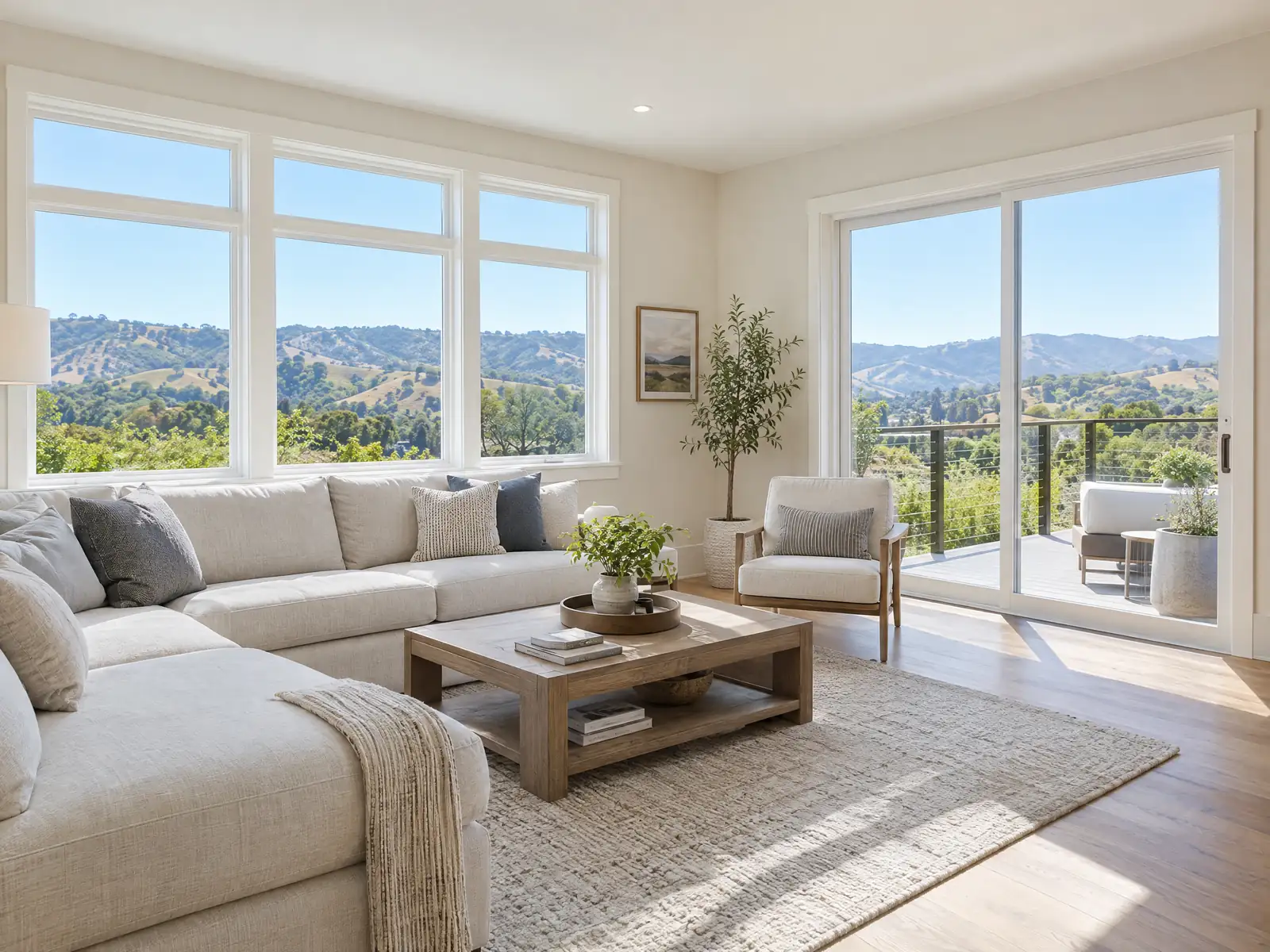
Windows
Replacement windows and sliding doors, with the LADBS permit path, glass ratings and sourced prices explained.
See window replacement →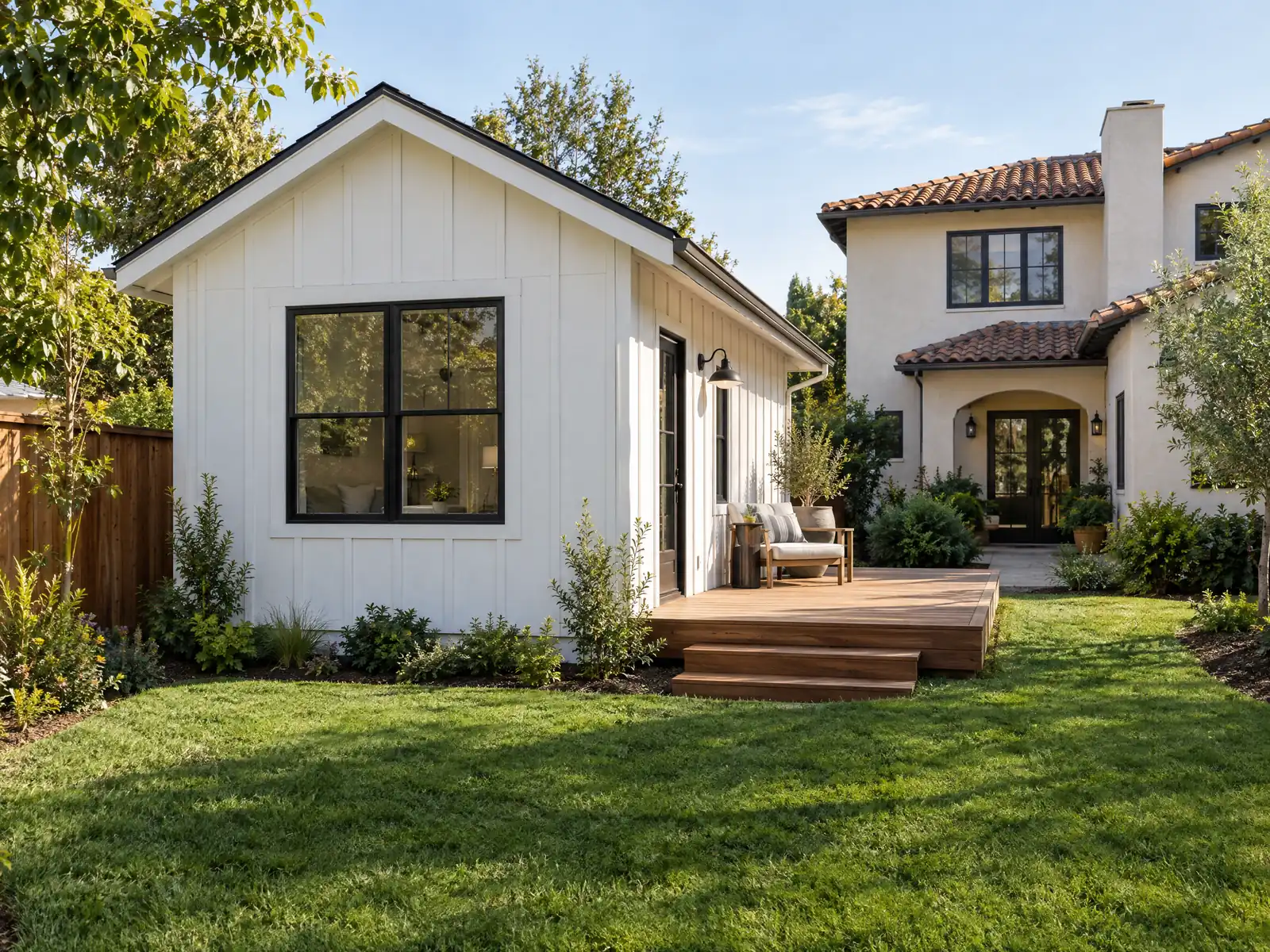
ADU Construction
Garage conversions, detached ADUs and JADUs, with the 2026 permit clocks, utilities and sourced costs explained.
See ADU construction →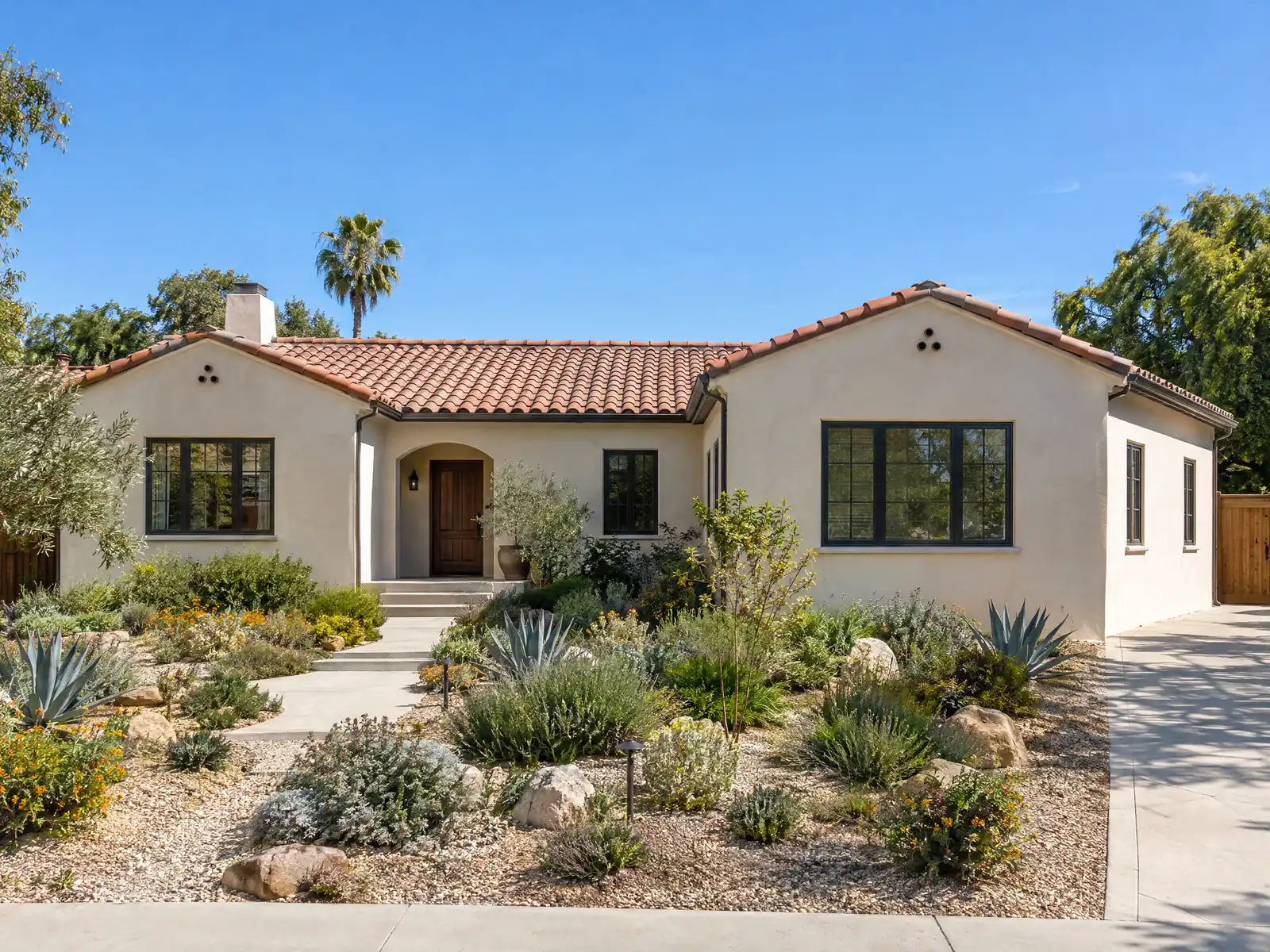
Room Additions
Family rooms, primary suites and second stories, from zoning check to final inspection, with sourced prices.
See room additions →Keep reading
Do You Need a Permit to Replace Windows in Los Angeles?
Same-size swaps are an LADBS Express Permit; new or resized openings are not. Plus how Santa Clarita, Irvine, San Diego and others differ.
Read the guide →Vinyl vs Fiberglass vs Aluminum Windows in California
How each window frame handles Southern California heat, wildfire zones and salt air, what each costs, and where a city can rule one out.
Read the guide →How Much Does Window Replacement Cost in Los Angeles?
Whole-house and per-window prices for Los Angeles with named sources, a twelve-window worked example, and the local rules that add cost.
Read the guide →Ready to plan your project?
Call or send the form. We schedule a site visit and send a written proposal.