
Do You Pay Impact Fees on an ADU Under 750 Square Feet?
No. California bars impact fees on an ADU with 750 square feet or less of interior livable space, and on a junior ADU of 500 square feet or less, under Government Code section 66311.5. Larger units pay a proportional share. School fees, utility charges and ordinary permit fees follow separate rules and can still apply.
What is an impact fee on an ADU?
An impact fee is money a local agency charges a new project to help pay for public facilities, such as parks, roads or libraries. It is not the fee for checking your plans. The Department of Housing and Community Development's ADU Handbook, March 2026 edition, defines it through the Mitigation Fee Act: any monetary exaction other than a tax or special assessment, charged in connection with approving the unit, to defray the cost of public facilities. For ADUs the term also takes in park fees under Government Code section 66477, often called Quimby fees.
One edge surprises people: an impact fee does not include a connection fee or capacity charge from a local agency, special district or water corporation. Those follow a different part of the same statute.
Older articles cite section 66324 for these rules. The text moved to section 66311.5 on January 1, 2026, and the handbook uses the new number.
How does the 750 square foot ADU fee exemption work?
At 750 square feet of interior livable space or less, the impact fee is zero. That applies to fees from local agencies, special districts and water corporations alike. A junior ADU gets the same treatment at 500 square feet or less.
The measuring stick is interior livable space, a term the 2025 amendments wrote into the law. The statute defines it as space in a dwelling intended for human habitation, including living, sleeping, eating, cooking or sanitation, and the handbook lists bedrooms, bathrooms, kitchens, laundry rooms, closets and interior stairs as examples. If your design sits near the line, ask the plan checker how the department measures before the drawings are final. Size also ties into the setback and height rules, where 800 square feet is the protected size.
What fees does an ADU over 750 square feet pay?
A share, not the whole bill. Above 750 square feet, impact fees must be charged proportionately, comparing the ADU's square footage with the main house's. HCD's own example: a 2,000 square foot house with a proposed 1,000 square foot ADU could be charged 50 percent of the impact fee a new primary dwelling would pay on that site.
Los Angeles fills in two practical details in its ZA Memo 143, Revision 1, dated August 1, 2025. County Tax Assessor records may be used to establish the size of the main house. On a lot with a multifamily building, the fee is proportional to the average size of all the units, or the applicant may simply pay the full fee.
A worked example: 740 square feet versus 900
Two designs for the same lot, behind an 1,800 square foot house. Design A is 740 square feet. Design B is 900.
Impact fees: Design A pays none. Design B pays 900 / 1,800 = 50 percent of what a new house would pay. Each city sets its own fees and we verified none, so we print no dollar amount.
School fees work on a different threshold, which is where owners get caught. A unit under 500 square feet is not subject to school impact fees, so both designs are over that line. School districts set their own rates up to a state ceiling. The State Allocation Board raised the Level 1 residential ceiling from $5.17 to $5.38 per square foot on January 28, 2026. At that ceiling, Design A would owe 740 x $5.38 = $3,981.20 and Design B 900 x $5.38 = $4,842. A 499 square foot studio would owe nothing.
So the 750 line saves Design A the impact fee and nothing else. Districts may charge less than the ceiling or use a fee level we did not research, so confirm the rate first.
Which fees does Los Angeles still charge on an ADU?
The city names its fee lines. LADBS Information Bulletin P/BC 2026-150, revised August 13, 2026, and ZA Memo 143 list them.
- Residential Development Fee (LAMC 21.13.3) and Dwelling Unit Construction Tax (LAMC 21.10.3): the two impact fees the size rule governs. Charged proportionately on the larger units.
- Park Fees (LAMC 12.33): ADUs and JADUs are exempt.
- Affordable Housing Linkage Fee (LAMC 19.18): ADUs and JADUs are exempt.
- LAUSD school fees: required for ADUs larger than 500 square feet.
- Plan check and permit fees: not impact fees, so no size exemption. We did not verify any amount.
- Trash service: the Fire Department requires a separate address for each unit, and the memo warns that a separate address may trigger separate trash fees.
Do water and sewer connection fees apply to an ADU?
It depends on how the unit is created. The handbook says an ADU built from existing space, and any JADU, shall not be treated as a new residential use when connection fees or capacity charges are calculated, unless it is built at the same time as a new single-family house. A garage conversion is the common case that benefits. For other ADUs, a connection fee or capacity charge must be proportionate to the unit's burden, based on its square footage or its drainage fixture units compared with the main house.
On the ground in Los Angeles, the Bureau of Engineering issues a sewer availability clearance for every ADU, and the LADBS bulletin says a detached ADU does not need an independent drainage connection when the existing service meets the current plumbing code. In unincorporated county areas, the County's ADU guidelines (version 4.1, October 10, 2024) list a Sanitation District fee receipt and a will-serve letter from the local water company among the agency items, and say a separate utility meter is not required. Trenching and concrete patching for a new line are construction costs, and no fee rule touches those.
Are fees waived when you legalize an older unpermitted unit?
Largely, for units built before 2020. The same LADBS bulletin, applying Government Code section 66311.7, says a homeowner permitting an unpermitted ADU or JADU constructed before January 1, 2020 is not required to pay impact fees, connection charges or capacity charges. The exception is where utility improvements are needed to meet health and safety standards.
The fee break does not remove the permit: the unit still goes through plan check and inspection, and the owner must document that it was built before the cutoff.
How to read the fee lines on an ADU proposal
Ask for every fee by name, on its own line, with the agency that collects it. A single line called permits and fees hides the difference between a charge the law waived and one that is merely estimated. MDG Builders, CSLB #1040337, runs ADU construction projects as the general contractor, so fee lines appear in our proposals as pass-through costs next to the work that licensed subcontractors perform.
The address decides which fee schedule applies. An ADU in Long Beach or Anaheim answers to that city's schedule and school district, and only the state rules above stay constant. Fees also come early, which matters if you are arranging ADU financing: Los Angeles counts payment of fees as part of a complete application, so they are tied to the permit timeline too.
- Which lines are impact fees, and were they zeroed or prorated by size?
- What school fee rate was used, and at what square footage?
- Is a new water or sewer connection assumed, and why?
- Are plan check and permit fees an allowance or a quote from the department's fee calculator?
- If an attached unit is on the table, how do the fees compare with a plain room addition?
ADU fee questions
How much are ADU impact fees?
Zero for an ADU of 750 square feet or less of interior livable space. Above that, the fee is a proportional share based on the ADU's size compared with the main house, so no single dollar figure applies statewide. Ask your city for its current schedule and the proration it used.
How much are ADU permits in Los Angeles?
We cannot give a verified figure, because plan check and permit fees come from the LADBS fee schedule for the specific work, and amounts posted online conflict. They are not impact fees, so the 750 square foot exemption does not reduce them. Ask for each fee as a named line with its source.
Do I need separate utilities for my ADU?
Usually not as a legal requirement. An ADU converted from existing space cannot be treated as a new residential use for connection fees, and LADBS says a detached ADU needs no independent drainage connection if the existing service meets code. LADBS does require a separate electrical panel and a water shutoff valve inside the unit.
How do you estimate ADU permitting costs accurately?
Build the estimate from the fee schedule, one line at a time. Sort each charge into impact fees, school fees, utility charges and plan check or permit fees, then apply the size rules: 750 square feet for impact fees and 500 for school fees.
Will my property taxes increase when I add an ADU?
Yes, on the new part only. The State Board of Equalization says newly constructed property is reappraised at its fair market value when the work is complete, while the existing house keeps its assessed value. The added tax follows the market value the ADU adds, which is not necessarily what it cost.
Are there ways to reduce the fees on an ADU?
Yes, and size is the main one. Keeping the unit at 750 square feet or less removes impact fees, staying under 500 removes school fees, and converting existing space avoids being charged as a new utility connection. The trade is less floor area.
Work that goes with this
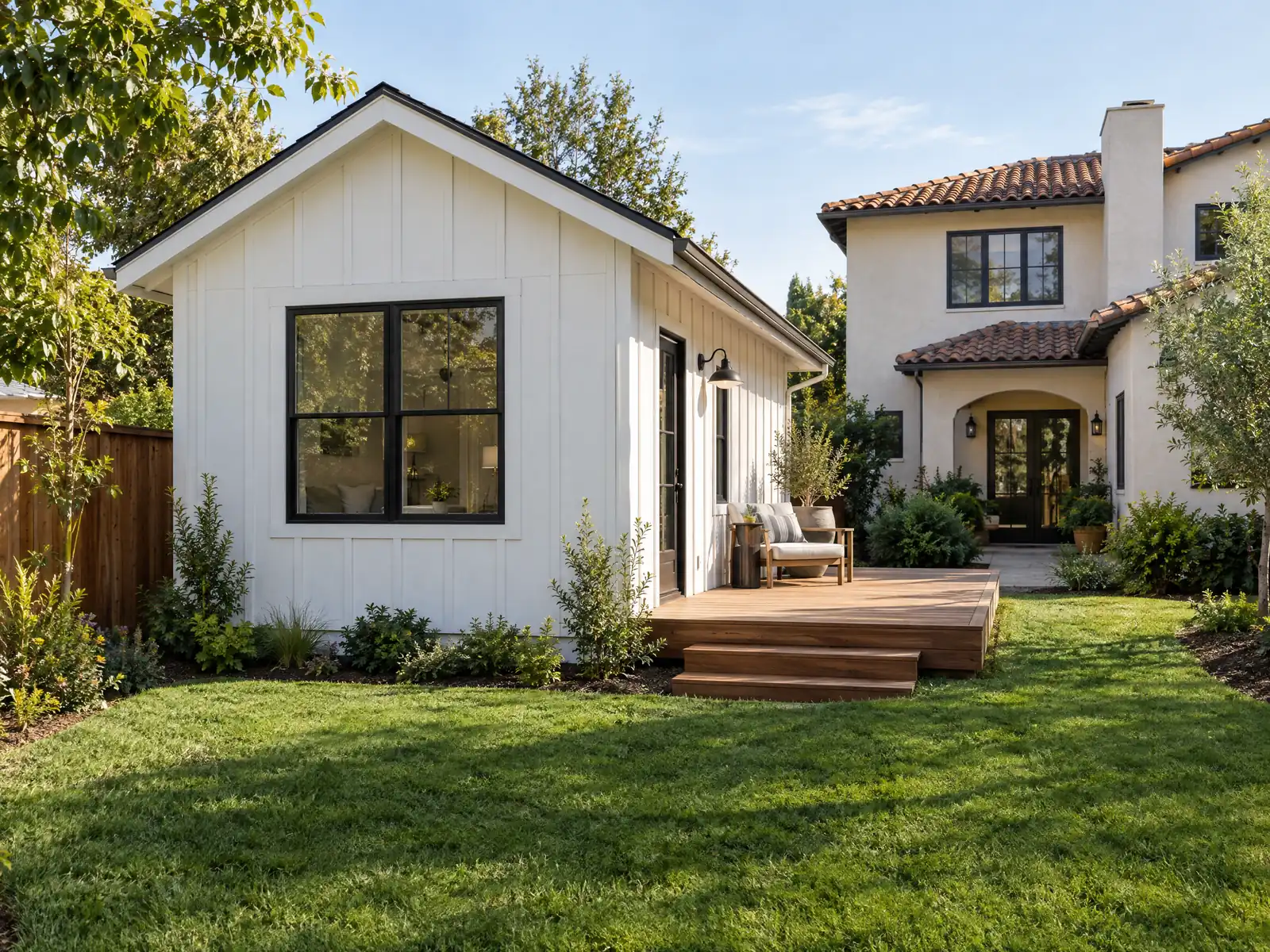
ADU Construction
Garage conversions, detached ADUs and JADUs, with the 2026 permit clocks, utilities and sourced costs explained.
See ADU construction →
Room Additions
Family rooms, primary suites and second stories, from zoning check to final inspection, with sourced prices.
See room additions →
Concrete
Patios, driveways, walkways and retaining walls, poured by licensed specialists and priced from sources.
See concrete work →More ADU cost guides
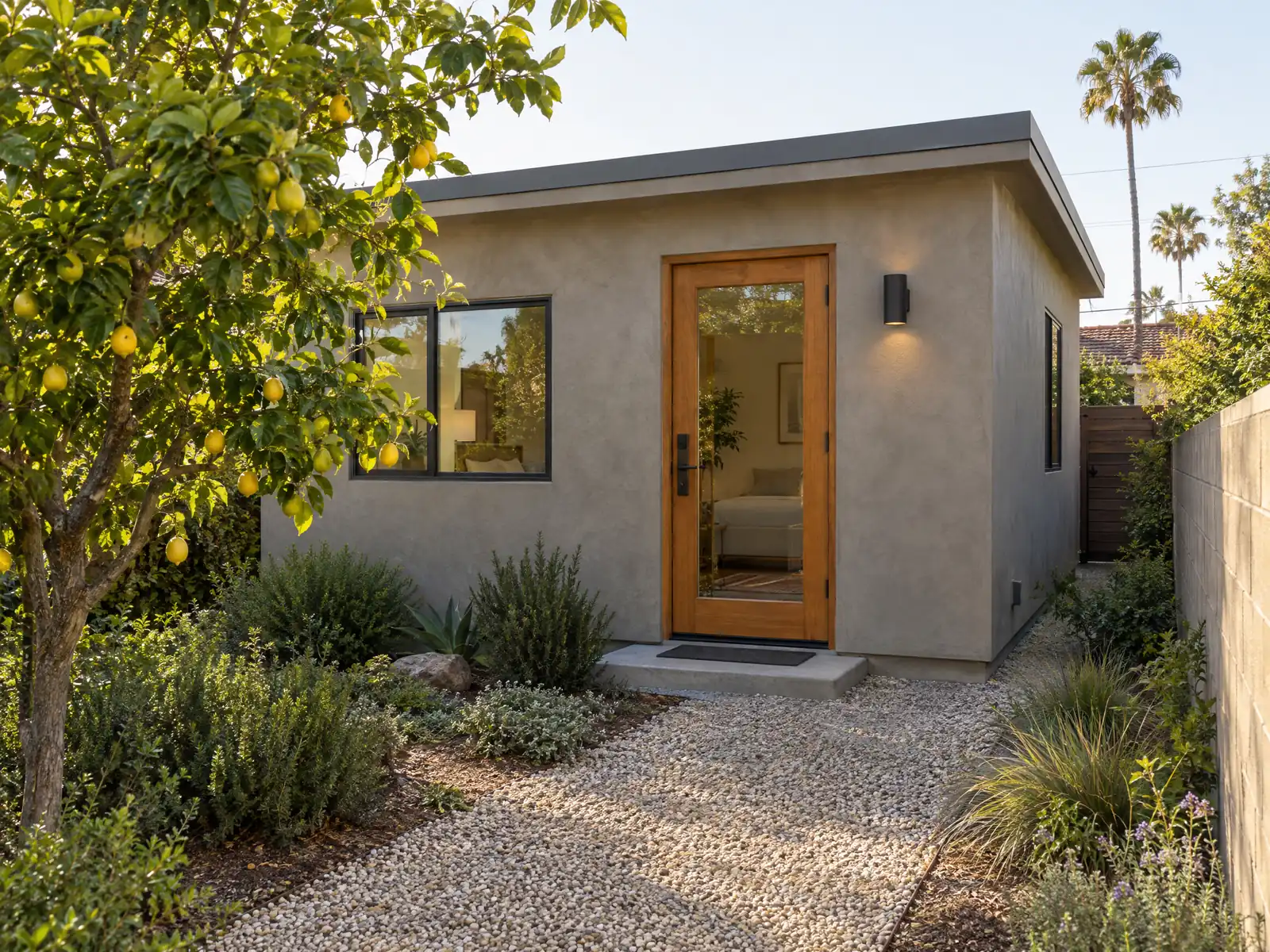
How Much Does an ADU Cost in California?
Sourced 2026 ranges for garage conversions and detached ADUs in Los Angeles, and how old the survey numbers are.
Read the guide →How Long Does an ADU Permit Take in Los Angeles?
The 15-business-day and 60-day state clocks, the Los Angeles clearances that sit outside them, and a day-by-day worked example.
Read the guide →How Do You Pay for an ADU in California?
Cash, HELOC, cash-out refinance, renovation mortgages and local loans, plus how lenders count ADU rent and where the state grant stands.
Read the guide →Ready to plan your project?
Call or send the form. We schedule a site visit and send a written proposal.