
How Close to the Property Line Can You Build an ADU in California?
A new ADU in California can sit as close as 4 feet from the side and rear property lines, and a converted garage can stay exactly where it stands with no added setback. Cities must also allow at least 16 feet of height for a detached ADU and cannot cap its size below 850 square feet.
What are the ADU setback requirements in California?
Four feet is the most a city can ask for on the sides and the rear. The Department of Housing and Community Development's ADU Handbook, March 2026 edition, states the rule from Government Code section 66314(d)(7): a setback of no more than four feet from the side and rear lot lines shall be required for an attached or detached ADU.
Conversions get a better deal. No setback at all may be required for an ADU or JADU created inside an existing living area or accessory structure, or for an ADU built as a new structure in the same location and to the same dimensions as an existing one. A garage sitting 18 inches off the fence can become a dwelling where it stands, as far as zoning goes. The building code is a separate question, covered below.
Can you put an ADU in the front yard?
Sometimes, and mostly as a last resort. A city may apply its front yard setback to an ADU, the handbook says, but the front setback cannot be used to block a unit of at least 800 square feet. If an 800 square foot ADU cannot fit in the back yard, the city must allow it in the front setback as needed.
The City of Los Angeles reads it the same way. Its ordinance requires a detached ADU to sit behind the main house, with limited exceptions such as through lots, and the city's ZA Memo 143, Revision 1, dated August 1, 2025, confirms the front setback cannot preclude a unit of up to 800 square feet that cannot be created elsewhere on the lot. For the unit types that Government Code section 66323 protects outright, no front setback may be imposed at all.
How tall can an ADU be: 16, 18, 20 or 25 feet?
State law sets no height limit of its own. It sets floors that a local limit cannot go under, listed in section 66321(b)(4) as the handbook summarizes it.
- 16 feet for a detached ADU on a lot with an existing or proposed single-family or multifamily home.
- 18 feet for a detached ADU within a half mile walking distance of a major transit stop or high-quality transit corridor, plus 2 more feet when the ADU roof pitch aligns with the main house, for 20 feet in all.
- 18 feet for a detached ADU on a lot with a multifamily, multistory building.
- 25 feet, or the height limit that zoning sets for the main house, whichever is lower, for an attached ADU.
In Los Angeles, a flat roof with a slope of 2 percent or less does not count as a pitch to match (ZA Memo 143, Q.38).
What is the maximum size of an ADU in California?
It depends on whether your city has its own compliant ordinance, and no city can squeeze you below a set floor. A local ordinance may set a maximum size, but that maximum must allow at least 850 square feet of interior livable space, or 1,000 square feet for an ADU with more than one bedroom. Where no compliant local ordinance exists, the state defaults apply: 1,200 square feet for a new detached ADU, and up to 50 percent of the existing home's floor area for an attached one.
Under all of that sits the protection most designs are built around. Lot coverage, floor area ratio, open space and front setback rules cannot be used to deny an ADU of at least 800 square feet with 4-foot side and rear setbacks. A city also may not set a minimum lot size, and it cannot set a minimum unit size that rules out an efficiency unit, which can be as small as 150 square feet.
Two notes. The limits now count interior livable space, and a converted garage or a converted part of the house has no size limit at all. The City of Los Angeles allows detached ordinance ADUs up to 1,200 square feet, per Table 1 of the memo.
A worked example: fitting an 800 square foot ADU on a 50 x 130 lot
Take a typical Valley lot, 50 feet wide and 130 feet deep, with 45 feet of yard behind the house. Start with width: 50 - 4 - 4 = 42 feet you can build across. A unit 40 feet wide and 20 feet deep is 40 x 20 = 800 square feet, and 40 feet fits inside 42.
Now depth. The rear setback takes 4 feet and the unit takes 20, so 45 - 4 - 20 = 21 feet remain between the ADU and the back of the house. State ADU law sets no distance between the two buildings, though building and fire codes can.
Compare an attached unit. If the house is 1,500 square feet, 50 percent is 1,500 x 0.5 = 750 square feet. That is under the 800 square foot floor, so the percentage cannot hold you to 750.
Does an ADU wall near the property line need a fire rating?
Often, yes, and this is where the zoning setback and the building code part ways. LADBS Information Bulletin P/BC 2026-150, revised August 13, 2026, says the exterior walls of a conversion that stand less than 5 feet from the property line must be 1-hour fire-resistance rated when the unit has no sprinklers, and less than 3 feet when it does.
Los Angeles County's ADU guidelines, version 4.1 dated October 10, 2024, say the same for unincorporated areas. In practice the wall closest to the neighbor is the wall where windows are hardest to add, and every sleeping room still needs an emergency escape opening onto a yard or public way. Our guide to egress window requirements covers those sizes.
Which lots get different ADU numbers?
The statewide figures are a starting point, and four situations change them.
- Coastal zone. A local coastal program can require additional setbacks, the handbook notes, which matters in beach cities such as Santa Monica and Newport Beach.
- Hillside and fire zones in Los Angeles. The city ordinance restricts ordinance-type ADUs on lots in both a Very High Fire Hazard Severity Zone and a Hillside Area. Per Table 1 of ZA Memo 143, that does not apply to the state-protected types.
- Utility easements. LADBS requires LADWP approval when a structure sits in a public utility easement or within 10 feet of one.
- Homeowners associations. Civil Code sections 714.3 and 4751 void CC&Rs that prohibit or unreasonably restrict an ADU on a single-family lot, per the handbook.
How do you confirm the setbacks for your own address?
Find the real property line first, then ask the right office in writing. A fence is not a survey. Each city runs its own building department, so an address in Pasadena gets a different counter than one in the City of Los Angeles, even though the state floors are identical.
MDG Builders, CSLB #1040337, handles this at the front of an ADU construction project: as general contractor we get the lot measured and the footprint drawn against the local standards before design money is spent, and licensed subcontractors build once the permit is in hand.
If the numbers leave no room for a detached unit, attaching it as a room addition with its own entrance, or choosing a junior ADU inside the house, are the usual alternatives.
ADU setback, height and size questions
How big can an ADU be in Los Angeles?
Up to 1,200 square feet for a detached ADU under the city ordinance, according to Table 1 of ZA Memo 143, Revision 1. Zoning limits such as lot coverage can reduce that, but they cannot push a unit below 800 square feet with 4-foot side and rear setbacks. Converted garages have no size cap.
Can you build a two-story ADU in Los Angeles?
Yes. The city ordinance allows detached ADUs up to two stories, not counting a basement, within the zoning height limit. For the state-protected detached type the limit is 16 feet, or 18 feet near transit with 2 more feet for a matching roof pitch, and a second story must be allowed if it fits.
How do I know my ADU will comply with my city's zoning rules?
Check the design against the state floors first, then your city's ordinance. A unit of 800 square feet or less, no taller than 16 feet, with 4-foot side and rear setbacks is protected statewide. Anything larger depends on local standards, so ask the planning counter in writing before you pay for full drawings.
Can my HOA stop me from building an ADU?
No. HCD's handbook says Civil Code sections 714.3 and 4751 make CC&Rs void if they prohibit or unreasonably restrict an ADU or JADU on a lot zoned for single-family use. The association can apply reasonable, objective design standards, and those may not include fees or other financial requirements.
Can you have two ADUs on one lot in California?
Yes, on most single-family lots. HCD's handbook says local agencies must allow at least one ADU converted from existing space, one junior ADU and one newly built detached ADU on the same single-family lot. The detached one is limited to 800 square feet under that state-protected path.
How far does an ADU have to be from the main house?
State ADU law sets no distance. HCD's handbook says a city may apply objective standards, but a minimum separation cannot be used to unreasonably restrict an ADU unless the building or fire code requires it. In Los Angeles, the passageway and space-between-buildings rule does not apply to the ADU.
Work that goes with this
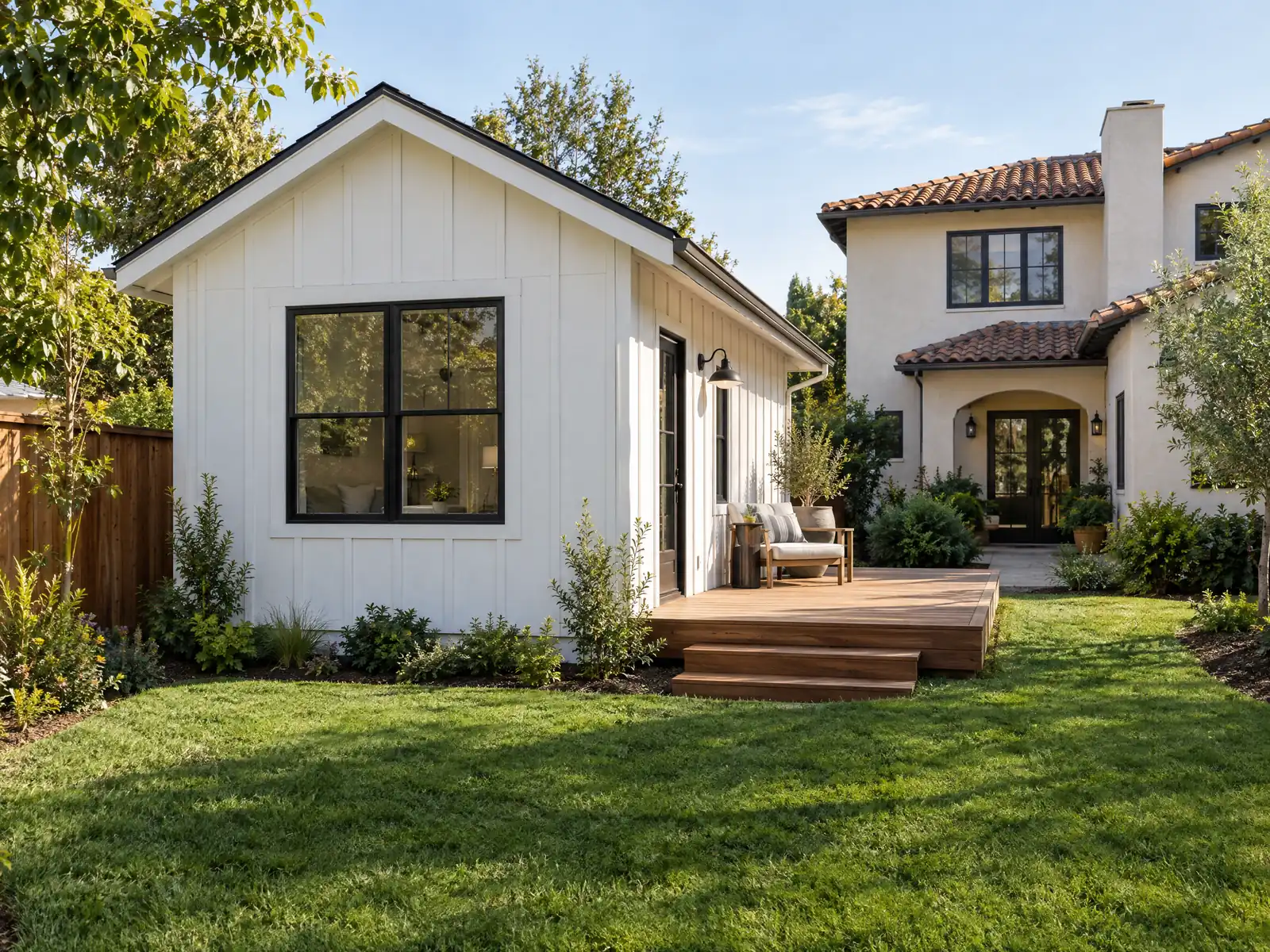
ADU Construction
Garage conversions, detached ADUs and JADUs, with the 2026 permit clocks, utilities and sourced costs explained.
See ADU construction →
Room Additions
Family rooms, primary suites and second stories, from zoning check to final inspection, with sourced prices.
See room additions →
Windows
Replacement windows and sliding doors, with the LADBS permit path, glass ratings and sourced prices explained.
See window replacement →More ADU rule guides
How Long Does an ADU Permit Take in Los Angeles?
The 15-business-day and 60-day state clocks, the Los Angeles clearances that sit outside them, and a day-by-day worked example.
Read the guide →
ADU vs JADU in California: What Is the Difference?
Size, kitchen, owner occupancy, rent rules and parking: how a junior ADU differs from a full ADU under current state law.
Read the guide →Do You Pay Impact Fees on an ADU Under 750 Square Feet?
What the 750 square foot exemption covers, what it leaves out (school, utility and permit charges), and the Los Angeles fee lines by name.
Read the guide →Ready to plan your project?
Call or send the form. We schedule a site visit and send a written proposal.