
Shower Waterproofing in California: What Does the Code Require?
California code requires shower surfaces to be waterproof up to 72 inches above the drain inlet, tile set on cement board, fiber-cement or glass mat gypsum backers, and a pan that holds water. Cities add a flood test before tile: Rancho Palos Verdes asks for 2 inches of water standing for at least 24 hours.
Is shower tile waterproof by itself?
No. Tile and grout shed most of the water, but grout is porous and every corner is a joint, so some moisture always gets behind the surface. The waterproofing is the layer under the tile, and it is the part of a shower you never see again once the job is finished. That is why building departments inspect it before tile goes on, and why it deserves more of your attention than the tile pattern does.
The rules below come from the 2025 editions of the California codes as two Southern California cities summarize them for homeowners: the Rancho Palos Verdes bathroom requirements, updated January 2026, and the City of Lake Forest's bathroom remodel handout, effective January 2, 2026. Your own city may amend them, so treat these as the baseline.
How high does the waterproofing have to go on shower walls?
To 72 inches above the drain inlet. Rancho Palos Verdes cites California Residential Code section R307.2 for that height and applies it to all surfaces of the compartment. Six feet is a minimum. A showerhead mounted high, a rain head or a tall user throws water above that line, so many installers carry the membrane to the ceiling in the wet zone. Ask which height your proposal assumes.
The compartment has its own minimums in the California Plumbing Code, as both cities list them. The finished interior must be at least 1,024 square inches and able to hold a 30 inch circle (section 408.7). The entry must leave a 22 inch clear opening (section 408.6). The drain is at least 2 inches (section 408.4 in Lake Forest's list), and the showerhead may not discharge directly at the entrance (section 408.9).
Which backer boards are allowed behind shower tile?
Cement board, fiber-cement board or glass mat gypsum backer. Rancho Palos Verdes names those three under Residential Code section R702.4.2. The same sheet is blunt about the common shortcut: water-resistant gypsum board, the purple or green drywall sold for bathrooms, may back tile only where there is no direct water exposure, such as behind a toilet or above a vanity. It cannot be used in a shower for direct application of tile.
- Sheet membranes are bonded to the backer with thin-set mortar and overlapped at seams.
- Liquid membranes are rolled or troweled on in coats to a thickness the maker specifies.
- Foam board systems combine backer and waterproofing, with sealed joints and fasteners.
- Traditional pans use a liner under a sloped mortar bed, clamped into a two-part drain.
Whatever the system, the maker's printed instructions set the overlaps, cure times and compatible drains. Ask for the product name in writing so the installation can be checked against them.
How is a shower pan flood test done?
The drain is plugged, the pan is filled, the water line is marked, and everyone waits. Rancho Palos Verdes states its rule in one sentence: shower pan tests must have 2 inches of water sitting for at least 24 hours, with the plug below the shower fitting, so the joint between the drain and the membrane is under water and tested too.
Membrane makers publish their own timing. Schluter's water test instructions say to wait at least 24 hours after the membrane is installed so the mortar in the seams reaches its final set, longer in cool rooms, then fill, mark the level and hold, with 24 hours as the typical period. For a shower with no curb, the same instructions call for a temporary dam at the entry so the floor can hold water at all. Where a test falls in the job is laid out in our week-by-week bathroom schedule.
A worked example: how much water is in the test, and what a small drop means
Take a pan 36 inches by 48 inches, filled 2 inches deep. Volume is 36 times 48 times 2, or 3,456 cubic inches. A gallon is 231 cubic inches, so the test holds about 15 gallons. Water weighs 8.34 pounds per gallon, which puts roughly 125 pounds on the pan for a full day. The slope toward the drain makes the true figure a little different, but the scale is right: this is a real load, not a splash test.
Now suppose the line has dropped one eighth of an inch the next morning. That is 36 times 48 times 0.125, or 216 cubic inches, a little under one gallon. A gallon inside a wall cavity is a serious leak. A gallon lost to a dry Santa Ana day is not a leak at all, which is why a careful tester covers the pan or sets a bucket of water beside it and compares the two levels. Check the ceiling or crawl space below as well. A test only counts if someone looks.
Curbless showers: how far past the entry must the floor be waterproofed?
Farther than the shower, and the two cities phrase it differently. Lake Forest says curbless showers require waterproofing of the whole bathroom floor, because the room is treated as a wet location. Rancho Palos Verdes says there is not necessarily an extension requirement, then recommends the entire bathroom as the ideal and 2 feet past the threshold edge as the next best. In Lake Forest the whole-floor version is the rule, so price it that way.
A level entry also changes the framing or the slab, because the floor has to drop to create slope where the curb used to hold water back. On a concrete slab that means cutting and re-pouring concrete, and on a raised floor it means reworking joists, which can need an engineer. Our tub-to-shower conversion post covers what that does to the price, and the microcement shower post covers a tile-free finish over the same kind of membrane.
Where do tiled showers leak, and what should you ask to see?
At changes of plane and at holes. No public agency we found publishes leak statistics, so this is a checklist of the places an inspector and a careful tile setter look, not a ranking.
- The curb: its top should slope into the shower, and glass hardware should not be screwed down through the membrane on top.
- Niches and benches: every inside corner needs membrane coverage, and horizontal surfaces need slope.
- The valve and showerhead openings: sealed to the membrane, not left as raw cuts in the board.
- The drain connection: the membrane must tie into the drain body the maker lists for it.
- The floor: sloped to the drain under the membrane, so water that reaches it keeps moving.
Who inspects shower waterproofing in Southern California?
The city or county building inspector, at a visit that happens before tile. Rancho Palos Verdes lists a drywall, interior lath and shower pan inspection that checks backing and waterproofing for tile and confirms the pan is waterproofed. Lake Forest lists shower pan and waterproofing among its rough inspections. In the City of Los Angeles, the building department's homeowner guide gives the general rule: call for inspection before covering any work. Our bathroom permit guide covers the permit that makes that inspection possible.
On an MDG Builders project, CSLB #1040337, we plan the shower, name the waterproofing system in the proposal and schedule the test and inspection, and a licensed tile subcontractor installs the membrane and tile. Take dated photos of the membrane and of the marked water line for your records. In Rancho Palos Verdes and other coastal cities, the same photos help if a condominium association asks for proof later. Both the bathroom remodeling and flooring pages describe how the tile work is scoped.
Shower waterproofing questions
Do I need to waterproof shower walls before tiling?
Yes. California code, as Rancho Palos Verdes summarizes it, requires shower surfaces to be waterproof up to 72 inches above the drain inlet, and tile must go over cement board, fiber-cement or glass mat gypsum backer. Tile and grout alone do not stop moisture.
Can you use green board or purple board in a shower?
Not behind shower tile. Rancho Palos Verdes's January 2026 requirements say water-resistant gypsum board may back tile only in areas without direct water exposure, such as behind a toilet, and cannot be used in a shower for direct application of tile.
How long should a shower pan flood test last?
At least 24 hours where the city sets it that way. Rancho Palos Verdes requires 2 inches of water for at least 24 hours with the plug below the shower fitting. Schluter also describes a 24 hour hold as typical. Ask your own building department for its depth and duration.
Can you use microcement in a shower?
Yes, as a finish over a proper waterproofing system. Microcement is a thin coating, and a shower built with it still depends on the waterproofing system underneath and the sealer the maker specifies. We did not find a California code text written for microcement, so ask the installer which membrane is used and have the pan flood tested like any other.
Does a curbless shower need the whole bathroom floor waterproofed?
In some cities, yes. Lake Forest's 2026 handout requires waterproofing the whole bathroom floor for a curbless shower. Rancho Palos Verdes recommends the entire room and accepts 2 feet past the threshold edge as the next best. Confirm the rule where you live.
What is the minimum size for a shower in California?
A finished interior of 1,024 square inches that can hold a 30 inch circle, under California Plumbing Code section 408.7 as cities cite it. That works out to 32 by 32 inches. The entry must also leave a 22 inch clear opening, and the curb may encroach on the minimum size.
Work that goes with this
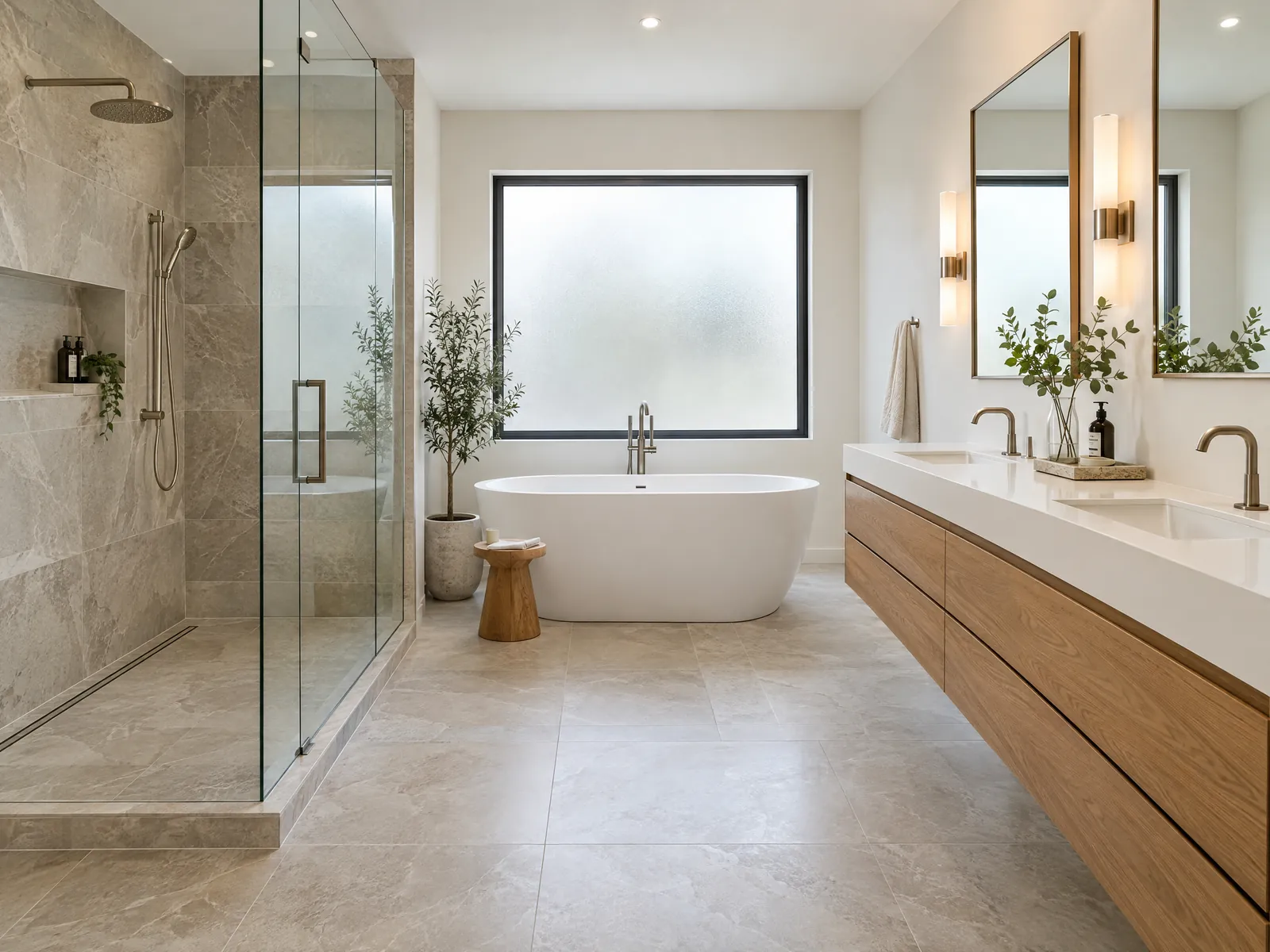
Bathroom Remodeling
Showers, tubs, vanities and full baths, with the permit path, waterproofing and prices from named sources.
See bathroom remodeling →
Flooring
Hardwood, engineered wood, vinyl plank, laminate and tile, with slab testing and a written scope.
See flooring →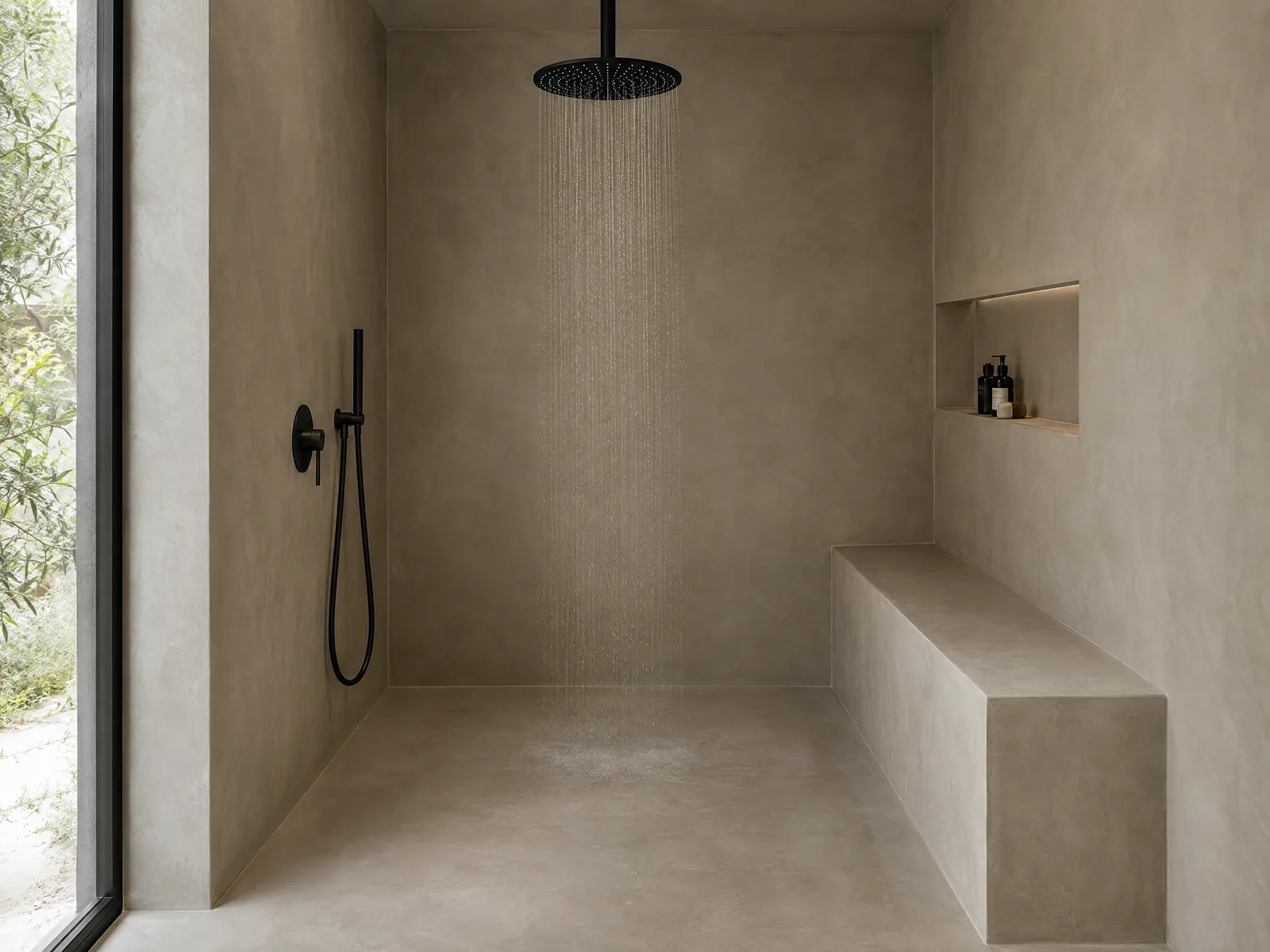
Microcement
Continuous cement-based finishes for floors, walls, counters and showers, with the prep and waterproofing explained.
See microcement →Keep reading
How Much Does a Tub-to-Shower Conversion Cost in California?
Dated national ranges by shower type, a line-by-line worked example, permit rules by city and what an accessible walk-in shower needs.
Read the guide →Does a Bathroom Remodel Need a Permit in Los Angeles?
Which bathroom work LADBS issues as an Express Permit, what goes to plan check, how nearby cities differ, and what the inspector signs.
Read the guide →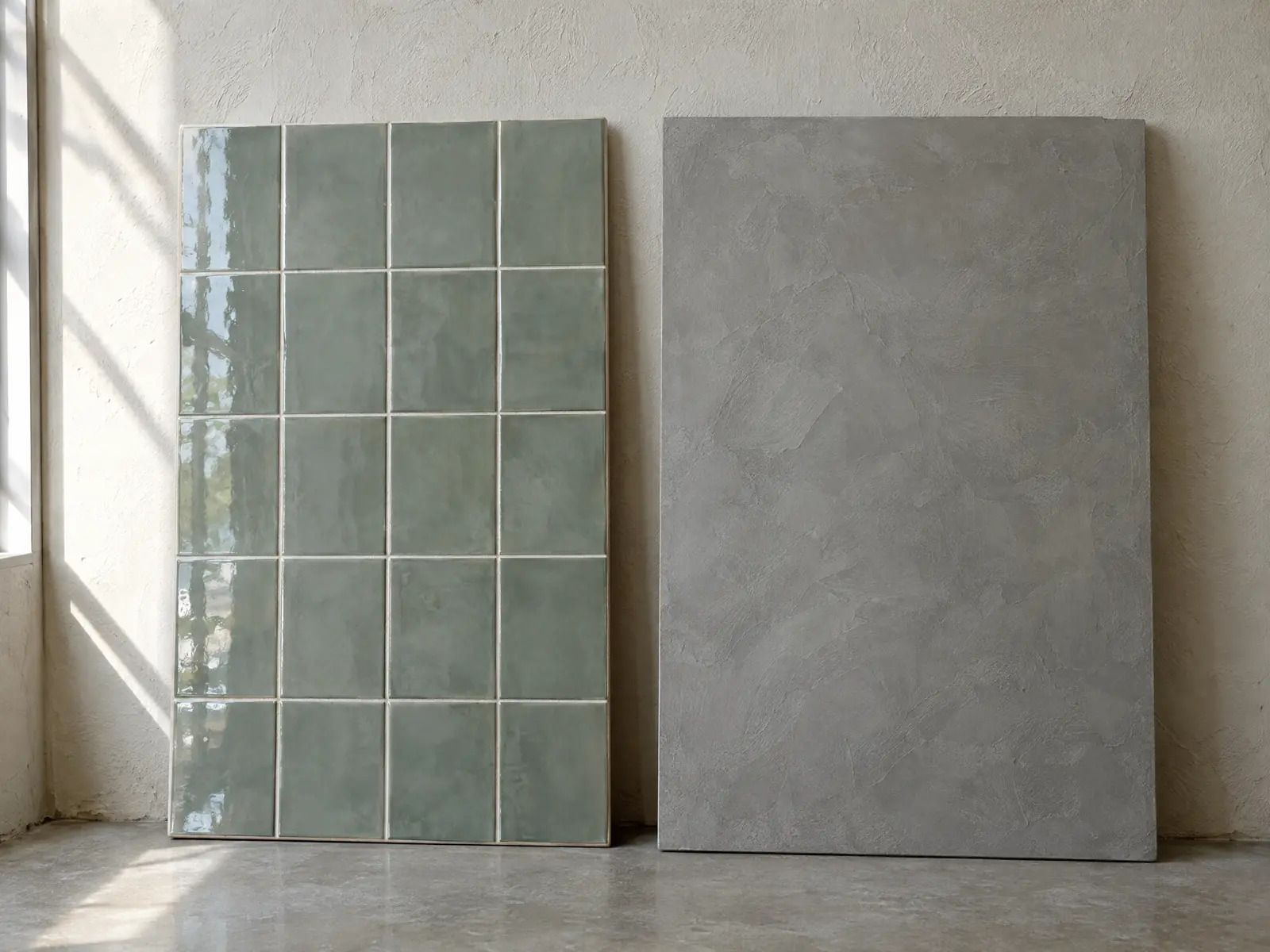
Microcement vs Tile: Which Holds Up Better in a Bathroom?
How microcement and tile differ in installation, wet-area performance and upkeep, using only facts we could verify.
Read the guide →Ready to plan your project?
Call or send the form. We schedule a site visit and send a written proposal.